
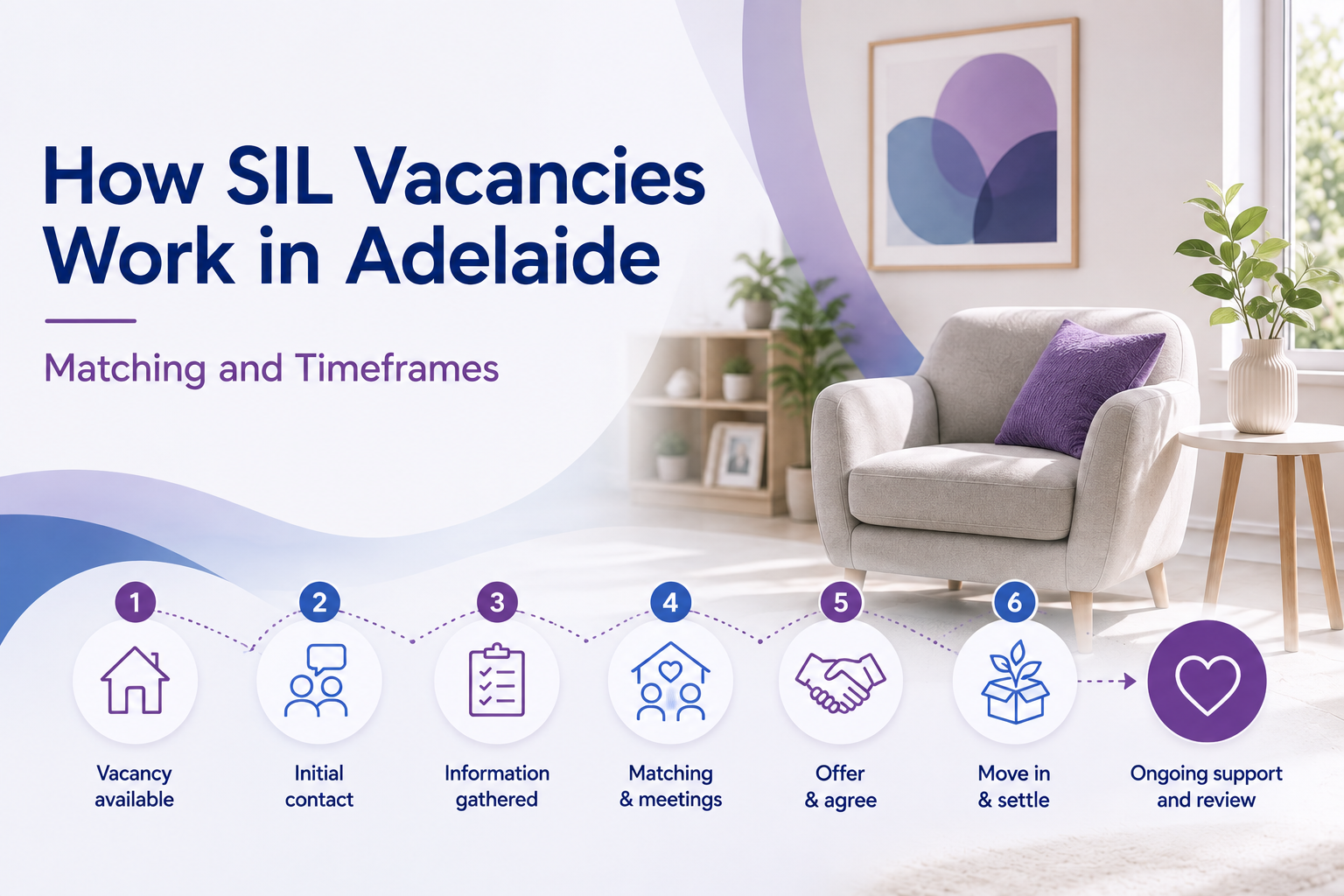
If you have been looking at supported independent living in Adelaide, you have probably seen vacancy listings: a room in a shared home, a suburb, maybe a photo. What the listings rarely explain is what happens next. How does a provider decide who a home suits? Who is involved? How long does the whole thing take?
This guide walks through the vacancy process from “there’s a room available” to “you’ve said yes”, so you know what to expect at each step and what is reasonable to ask along the way. It is written for participants, families and support coordinators looking at SIL homes in Adelaide, but the process is much the same anywhere.
What does a SIL vacancy actually mean?
Supported independent living, or SIL, is NDIS funding for support workers to help or supervise you with day-to-day tasks in your home, in many cases 24 hours a day, 7 days a week. You might share a support worker with housemates or have individual support, depending on your needs. The important thing to understand is that SIL is funding for the support workers, not for the house itself. The housing is separate: some people also have specialist disability accommodation (SDA) funding for a specially designed home, while others pay rent the same way anyone else does.
So when a provider advertises a SIL vacancy, they are really saying two things at once: there is a room available in a home, and there is an established support arrangement in that home that a new person can join. The people already living there have their own funding, their own routines and their own say in who joins them. That is why filling a vacancy is a matching process, not a booking.
Who is involved in filling a vacancy?
Usually four groups of people:
- You and your family or supporters. You are the decision-maker throughout. Nothing proceeds without your agreement.
- Your support coordinator, if you have one. Most people with SIL funding also have support coordination funding, and part of a support coordinator’s role is helping you find and compare providers. They will often be the one who first contacts providers about a vacancy.
- The provider. They manage the home’s supports, know the current residents, and assess whether the home can safely and comfortably meet your needs.
- Sometimes your clinicians or therapists. If you have complex support needs, an occupational therapist’s input on accessibility, or information from your health team about your support requirements, helps the provider work out whether the home is genuinely suitable.
How does matching actually work?
This is the part of the process most listings never mention, and it is the part that decides whether a placement lasts.
A responsible provider will look at fit across several areas before offering you a room:
Support needs. Can the home’s staffing arrangement meet your needs? A home staffed for daytime support suits different people than one with support workers on site around the clock. If you need nursing or high-intensity supports, ask directly whether the home’s team delivers them; in Nurse Aid Australia’s SIL homes, nursing support is available on site, which matters for people with clinical support needs that most share houses cannot accommodate.
Housemate compatibility. Age, interests, routines, noise levels, sensory preferences, how people like to spend evenings and weekends. Providers should talk with the current residents about what they are looking for in a new housemate, and current residents should have a genuine say.
The home itself. Accessibility, bathroom setup, bedroom size, distance from your family, transport, day programs or work.
Expect the provider to ask for information about your supports, to meet you (usually more than once), and to arrange introductions with the people you would be living with. If a provider offers you a room without asking any of this, be cautious rather than flattered: a placement made without matching is the kind that breaks down.
How long does it take?
Honestly: there is no standard timeframe, and anyone quoting you one is guessing. The two biggest factors are:
Whether SIL funding is already in your plan. If it is, the process is mostly matching and paperwork, and it can move in weeks. If it is not, the funding decision comes first: you will need to work with your support coordinator to put evidence of your home and living needs to the NDIA, and that assessment takes time. Start conversations with providers anyway; knowing what homes exist helps shape your request.
How careful the matching is. Visits, meetings and a proper conversation with the people already living in the home take longer than a same-week move-in. That time is not delay, it is the placement being done properly.
What should you ask before saying yes?
At minimum: who else lives in the home and what is the staffing arrangement; what happens if your support needs change; how the household handles disagreements; what you would pay for rent and day-to-day living costs as distinct from what your NDIS funding covers; and what the exit arrangements are if it does not work out. We have a full list in our guide to 7 dealbreaker questions to ask an Adelaide SIL provider, written for exactly this stage of the process.
One more worth asking anywhere: is the provider registered? From 1 July 2026, providers delivering SIL must be registered with the NDIS Quality and Safeguards Commission, which brings independent audits, practice standards and worker screening requirements. Nurse Aid Australia is an NDIS-registered provider.
What happens after you accept?
Two documents make it real. A service agreement sets out the supports the provider will deliver and how your funding will be claimed. A roster of care is a planning tool you and the provider agree on, showing what supports are in the home each week and how they are delivered. Read both, ask questions about anything unclear, and do not sign on the spot if you want time to think.
Then comes the move itself, which is its own process: we have covered it step by step in Moving Into a SIL Home in Adelaide: Complete Guide.
Frequently asked questions
Does SIL funding pay for my rent? No. SIL funds your support workers. Rent, board and everyday living costs are separate, paid the way anyone pays them, and some people have separate SDA funding for the home itself.
Can I choose my housemates? You choose whether to accept a home, and good providers involve current residents in choosing who joins them. You will not usually assemble a household from scratch through a vacancy, but you should always meet the people you would live with before deciding.
Do I need a support coordinator to apply for a vacancy? No, you or your family can contact a provider directly. Most people with SIL funding do have a support coordinator, and they make the comparing and paperwork easier.
Do SIL providers need to be NDIS-registered? Yes. From 1 July 2026, SIL providers must be registered with the NDIS Commission.
Can I visit a home before applying? Ask, and expect yes. Providers should be willing to show you the home and introduce housemates before anyone commits, subject to the current residents’ privacy.
How do I find current SIL vacancies in Adelaide? Your support coordinator can search on your behalf, the NDIS Provider Finder lists registered providers, and providers list their own vacancies. Nurse Aid’s current homes with rooms available are on our vacancies page.
Looking at SIL homes in Adelaide? See our current vacancies or talk to our team about our homes and how matching works on 1300 413 633.